In every family, someone ends up with “the stuff.” It is the goal of The Family Curator to inspire, enlighten, and encourage other family curators in their efforts to preserve and share their own family treasures.

Next Edition:
Sept 2010


Entries in NEHGS (8)

Wednesday
May052010

Get Away for Research at NEHGS

My favorite New England library, the New England Historic Genealogical Society, has just announced dates for the Summer 2010 Come Home to New England research sessions, June 14-19 and August 9-15. I attended the Spring Research Getaway in 2009 and consider it a "must-do" for New England researchers.

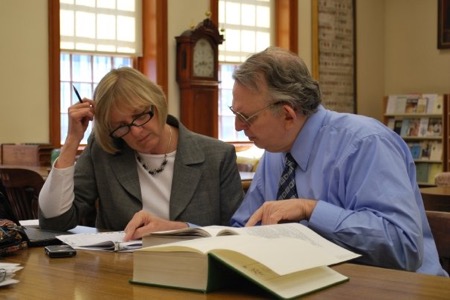
My three-part review of the week is included in the NEHGS announcement (along with a nice photo of me with staff expert Gary Boyd Roberts).

If you have been thinking about making a date for some serious research, sign up for this program soon. The small number of available spots mean that it will fill up quickly.

Read more on NEHGS research programs, the Family Curator Visits NEHGS Spring Research Getaway 2009:

Part 1: Preparing to Research

Part 2: Consulting the Experts

Part 3: Researching at NEHGS


Thursday
Apr012010

Ellen DeGeneres Related to Halle Berry who is related to. . . -- NEHGS


Now THAT's a family of celebrities. Genealogy super-star sleuths Christopher Child and Rhonda McClure at the New England Historic and Genealogy Society have discovered that Ellen DeGeneres is related through an "ancestral circle"(*)  to a remarkable number of celebrities.

“We’ve done lots of research that connects various celebrities and public figures," commented Childs. "This is the first time I’ve discovered a large circle of relationships like this. Genealogically speaking, this is pretty rare and amazing.”

Childs and McClure were first asked to research Ellen's genealogy in 2008, when the relationship to Halle Berry was discovered. It has taken many months to find Ellen's extended "family."


According to NEHGS, Ellen is related to

  • Halle Berry who is related to
  • Mark Wahlberg who is related to
  • Madonna who is related to
  • Camilla Parker-Bowles who is related to
  • Diana, Princes of Wales who is related to
  • Tim Robbins who is related to
  • Richared Gere who is related to
  • Ellen

All those cousins and once removeds put some relationships a bit far back in the timeline, but does royalty ANYwhere do anything to increase the chance of being called Lady Ellen?

Read the full story and see Ellen's celebrity wheel with all the connections at http://www.newenglandancestors.org/.

See a clip from The Ellen DeGeneres show with Ellen showing off her celebrity relationships.

* - don't look for a definition of "ancestral circle". I just coined it to identify relationships through an ancestor to a wider circle of people. Sort of a "six degrees of Kevin Bacon" thing.

Friday
Jan292010

Brown and Obama are Cousins, NEHGS Research Reveals

It's always interesting to see how fast the New England Historic Genealogical Society can research and write up the newsmakers of the moment. This morning I recieved word from Tom Champaux that researchers at NEHGS had uncovered the common ancestor of President Barack Obama and Republican Massachusetts Senator-Elect Scott Brown,

Obama’s mother, Stanley Ann Dunham, and Brown’s mother, Judith Ann Rugg, both descend from Richard Singletary of Haverhill, Mass, who died in 1687 at the age of 102. Singletary, like his two descendants Obama and Brown, held public office, serving as town selectman in both Salisbury and Haverhill, Massachusetts in the 1650s.

President Obama descends from Richard’s eldest son, Jonathan Singletary, who later changed his surname to Dunham. Scott Brown descends from Jonathan’s brother, Nathaniel Singletary. This kinship makes Obama and Brown 10th cousins.

Research by Christopher Child and David Allen Lambert goes on to find that politics seem to be a strong current in the family line. President Obama and Senator-elect Brown are also related to George H. W. Bush, George W. Bush, Richard Nixon, Calvin Coolidge, Herbert Hoover, and Rutherford Hayes.

Read the Press Release and view the Brown-Obama Family Tree at the NEHGS web site.

Monday
Jul062009

Yankee Savings at the New England Historic Genealogical Society


The New England Historic Genealogical Society once again sent a team of experts and staff members to the recent Southern California Genealogical Society Jamboree in Burbank and made themselves available for research assistance as well as presenting special sessions on New England topics. Their tables were always lively and crowded; I learned that it is wise to purchase books on the first day as they sold out as the weekend progressed.

An email from Tom Champoux, Director of Marketing, confirmed NEHGS' popularity. Tom noted that at Jamboree 2009 the team enrolled 53 new members, almost double the typical conference record, but this year's registration for new members topped even that number at 80 new memberships. It looks like a lot of Southern Californians are anxious to research their New England roots.

If you missed the NEHGS booth or didn't attend Jamboree, you may want to consider a terrific discount offered during the month of July for new memberships. The regular research membership costs $75, but new members can enroll through the end of July for $60 -- a savings of $15. What thrifty Yankee wouldn't like that?

More information about membership benefits is available at the NEHGS website. If you have New England ancestors or if you just love American history, this society is well worth the price of admission. With more online collections added all the time, membership at NEHGS is on the top of my renewal list.

Wednesday
May132009

Family Curator Visits NEHGS Spring Research Getaway 2009, Part 3: Researching at NEHGS

Note: This is Part 3 of a three-part review "Family Curator Visits NEHGS Spring Research Getaway 2009" focusing on the three-day program and the one-on-one consultation sessions.
Part 1: Preparing to Research
Part 2:Consulting with the Experts

Three full days of research at the New England Historical Genealogical Society Library may sound like quite a bit of research time, but it is not surprising that it is still not quite enough. Day One I spent mostly in consultations with the NEHGS experts. The Library was open in the evening, but I left about 5pm to join my husband for dinner, and did not take advantage of the extra research time.

I vowed to be Focused on Day Two, and went to work immediately after Josh Taylor's excellent presentation on source citation. I have always been a "browser" and took full advantage of the library's open stack policy to examine the volumes on hand for my localities of interest. A handy photocopy machine made quick work of copies for my records, and then I was off to the microtext room where I was pleased to discover the full-text films of the Vermont probate records. Julie Otto helped me conquer my fear of film machines and before long I was making digital copies of the films to examine more closely when I returned home.

Day Three promised considerable progress, but I had to leave the program at noon and could only attend the morning lecture by Judy Lacey on manuscripts in the HisGen archive collection. Her excellent presentation gave me so many ideas for further research: I would like to return and examine some of the letters, diaries, and journals in the collection with an eye toward finding friends or relatives of my ancestors. I was awed by the extent of the Society's collection; there will be wonderful discoveries in the years to come from this archive.

So, what will I research on my NEXT visit?

Local Histories
Maps and Gazetteers
Manuscript Collection
more Family Histories
Probate Records
Military Records
I was determined to use NEHGS resources that are unique to the Library, yet I found myself reading microfilms (can't I get these elsewhere?) and examining various printed volumes. When I returned home and did an internet search at World Cat for the same volumes I found that I would have to request the films from the local LDS Family History Center or visit NEHGS! This reaffirmed my appreciation for the HisGen collection, and made me more than a bit jealous for those researchers who live within easy driving distance of the library. I was also pleased that I had been able to use the digital copy machine to make copies of the microfilms I examined; this will give me many more hours of research time from home as I transcribe documents with the aid to computer enhanced images.

Of course, the online databases also provide unique access to the NEHGS collections. I have found my ancestors in the Rhode Island Vital Records Index, in the Newspaper Archive collection, and in various other digitized resources. The recent addition the indexed TAG articles with The NEHGS Register make this resource indispensable for any researcher working with New England records.

My experience at HisGen not only extended my pedigree, it also helped me feel confident to tackle research elsewhere. I think this was one of the greatest benefits of the program, I practiced "learning to learn." Thank you NEHGS.

Friday
May082009

TAG Now Available Online Through NEHGS

One more good reason to be a member of the New England Historic Genealogical Society -- The American Genealogist (TAG) is going online thanks to a new collaboration in which NEHGS will digitize back issues of the journal and make them available at the Society website, NewEnglandAncestors.org.

Founded in 1922 by Donald Lines Jacobus, TAG is edited by a trio of NEHGS members: Dr. David L. Greene, FASG, past recipient of the Society’s Coddington Award of Merit; Robert Charles Anderson, FASG, director of the NEHGS Great Migration Study Project; and Joseph C. Anderson II, FASG, who is also editor of The Maine Genealogist. These distinguished genealogists, along with dozens of highly-regarded contributors, uphold and advance the standards for genealogical scholarship so carefully articulated by Jacobus and the Jacobus “School.”
Volumes 1-8 of TAG covering 1923-1832 are already available online at the NEHGS website under the title “Families of Ancient New Haven.” The new searchable database adds Volumes 9–13, published between 1933 and 1937. Additional volumes are slated to be published through Volume 82, at which time new volumes will be added to keep the database current. The most recent five years will not be available online.

This is great news for genealogists worldwide who can now access the wealth of information in TAG through the internet. Randy Seaver included the full press release at Genea-Musings today; I second his enthusiasm about this new collaboration, and hope that we see even more journals "go digital" in the future.

Wednesday
May062009

Family Curator Visits NEHGS Spring Research Getaway 2009, Part 2: Consulting with the Experts

Note: This is Part 2 of a three-part review "Family Curator Visits NEHGS Spring Research Getaway 2009" focusing on the three-day program and the one-on-one consultation sessions. In "Part 1: Preparation" I address some of my own questions before attending the program and review registration and pre-event preparation. In Part 3, I will discuss research opportunities at NEGHS.

Mention "bricks" to a genealogist, and the image of a brick wall appears, followed by proposed strategies for climbing or demolishing the obstacle. But there is another use for bricks as well, one used with great care and skill by the staff at the New England Historic Genealogical Society. My experience at the 2009 Spring Getaway demonstrated the value of building a firm research foundation that can withstand any amount of weight as the evidence grows, brick upon brick.

Day One of the program, attendees met in the second floor education center the library. Conversation was already lively when I arrived and the room full of participants and friendly staff members. The program began with introductions from each member of the entire staff. I had stopped by briefly the day before and met a few people; it was helpful to see them again and put a name with a face. Staff members introduced themselves and explained their responsibilities at the Society or outlined their areas of expertise. From Event Coordinator, to Archivist, to Genealogist, to CEO, the entire staff were present to offer their assistance.

Then it was the participants' turn to briefly introduce themselves and their goals for the session. Attendees came from New England, Tennessee, West Virginia, New York, Colorado, and California. Some participants had also attended the NEHGS research trip to Washington D.C. and were now ready to conduct more research at the Society Library.

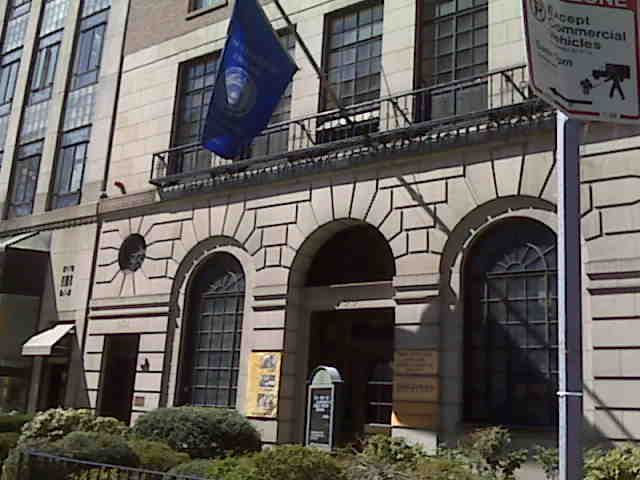
Marie Daly, Library Director, opened the lecture series with a virtual tour of the library collections. The Library itself is spread out over six floors in an former bank building on Newbury Street in Boston's Back Bay. The old teller's windows are still visible in the wood-panelled Reading Room on the first floor, but a modern elevator eases access between floors. The second floor holds the Education Center, a spacious room well-equipped for audio-visual presentations, receptions, and meetings; and the third floor holds Staff and Administrative offices. The Society's collections are housed on the first floor (International Books), fourth floor (microtext documents), fifth floor (local history), fifthA Floor (special collections), and sixth floor (open stacks and reading room). Marie's armchair tour was an efficient way to become familiar with the general layout of the library and the collections.

Following the lecture, participants were invited to sign up for individual consultations with the HisGen resident experts, what Ryan Woods likened to the legendary "Running of the Bulls." Good manners ruled the day, and I found open appointment times even as one of the last to sign the sheets. I was especially impressed with the staff's good-natured willingness to assist attendees at unscheduled times, and found them to be helpful and patient with my questions.

My consultation schedule for the first day was rather full, but it left me with lots of ideas for research on the second day, and a few remaining consultations. I was able to meet individually with several NEHGS staff members during the program, and look forward to working with the experts I missed in the future, among them Marie Daly, David Dearborn, David Lambert, Michael Leclerc, Gary Boyd Roberts, and Tim Sallis.

First, I spoke with Joshua Taylor from the Research Services Department, who offered his experience with technology and website creation. We discussed copyright protection through PDF watermarks and he gave me some ideas for design and marketing with The Family Curator blog.

Later in the day I met with Judy Lucey, Assistant Archivist, to discuss preserving my own collection of family papers and photographs. It seems that as much as I have read about preservation, I still had questions, and it was helpful to talk pointedly with an expert in the field. Judy told me about HisGen's own archival protocol for working with historic photographs, and suggested some ways that I could economically and easily organize my collections.

I was organizing my papers (and my thoughts) in the sixth floor reading room, when D. Brenton Simons, President and CEO of the Society stopped to chat. I was so glad to have the opportunity to talk with him about publishing opportunities for my research, and hope to pursue some of these ideas in the future.

I also met with Julie Otto, Genealogist, and solicited her help over and over in my attempts to master the microfilm reader and scanner. Eureka! We did it. Julie is a phenomenol resource with unlimited enthusiasm. She seems to know just where to find any probate record or local history, and was always ready to help, even during a late-night, last-night marathon session. It was fun to discover that we were nearly born in the same hospital (Queen of Angels, Los Angeles) during the same week of the same year (I'm not telling!). Maybe genealogy was in the stars that year!

My final "official" consultation was with Rhonda McClure, one of my favorite authors. I showed Rhonda the first few pages of a 1852 court case that had me stumped: Heirs of James Winsor vs. Calvin French et. al. With some deciphering, we determined that my ancestor James Winsor, appeared to be "intemperate" (i.e. a man who liked his liquor) and that after his death his estate had been presented with many bills, among them bills to his father-in-law who seems to have paid for his "board and other things" for nearly two years. Funds were deposited in a Rhode Island bank from the sale of Vermont property, and any number of claims and settlements seem to have been litigated. I had been focusing on researching the problem in Vermont, but Rhonda encouraged me to pursue Rhode Island connections, opening the door to a wealth of available documentation and research. Her enthusiasm was contagious, and I left our discussion charged for action.

I had only one more "Have to meet" on my list, and I was able to find Chris Childs in a free moment to explain a "Childs" research problem. My mother and I met Chris briefly at last year's Southern California Genealogy Jamboree in Burbank, and Mom was sure that "of course he's our cousin" Chris Childs would know just how "our Fanny Childs" fit in the big picture. We knew our ancestor Henry Winsor had married Fanny Childs, but we couldn't find her parents. With information from Aunt Mercy about Fanny's supposed father David Childs, Chris found her in the Childs, Childe family genealogy book; the problem was that she was young enough to be his grand-daughter. Aunt Mercy's note about a second wife gave us a clue, and by searching her name we found a likely family in the next census where the widowed mother was living with a child Fanny's age. A wonderful push in the right direction, thanks to Chris' knowledge and work with the Child/Childe family line. As icing on the cake, Chris then showed me the connection in Ancestors of American Presidents by Gary Boyd Roberts with charts prepared in part by Christopher Challender Child from originals by Julie Helen Otto. It would seem that Fanny is leading us on to other family connections. Maybe Aunt Mercy knew a thing or two after all.

In his introductory remarks, Ryan Woods noted that availability and expertise of the NEHGS staff is one of the hallmarks of HisGen programs, and I must add my applause to his remarks. The knowledge, enthusiasm, and patience of each genealogist and staff member I met excelled my expectations. My philosophy for attending workshops, classes, seminars is simple, "If I learn one new thing, it's worth the price of admission." Sometimes, I learn two new things, and feel elated. I attended the Spring Research Getaway hoping to learn one or two new things about researching my New England ancestors; my experience showed that the program was a bargain. I learned foundation-building skills that are invaluable, met scores of helpful, knowledgeable people, and feel confident to tackle the next research goal with enthusiasm and focus.

Thursday
Apr302009

Family Curator Visits NEHGS Spring Research Getaway 2009, Part 1: Preparing to Research


Note: This is Part 1 of a three-part review of my recent research trip to NEHGS. I have tried to address some of my own questions before attending the program for those who are considering research at the Library, and hope my comments are helpful. In Part 2, I will review the one-on-one consultation sessions, and in Part 3, I will discuss research opportunities at NEGHS.

It has been one of my long-time goals to research my family history at the New England Historical Genealogical Society, and this month I was able to take advantage of the Spring Research Getaway offered each year by NEHGS. I classify myself as an Advanced Beginner in genealogical research, and I knew that I would benefit from an orientation and assistance in using the extensive collections at HisGen.

The three-day Spring Research Getaway promising guided research with one-on-one consultations and special access to the collections appeared to be well-suited for my needs, and I was not disappointed. My experience with NEHGS was very positive from my first correspondence in January. Questions were answered promptly, and information about the program was directed to help me be successful in my research goals.

I admit that I was quite nervous about attending the program; concerned that my research goals would be either too "big" or too "small." Although I have a graduate degree and know my way around a university library, I've always felt intimidated by microfilm readers and was sure that I would have an awful time with those monsters. I was also traveling alone for part of the trip, which is its own issue. Happily, by the time I left home for Boston I felt ready to research and confident that I would be able to accomplish at least some of my goals.

Shortly after registering for the program I recieved an email letter and several attachments from Ryan Woods, Director of Education. In addition to travel information, schedule, and liability waiver, the packet included a Participant Interest Sheet. The accompanying "Tips for Completing Your Partipant Interest Sheet" was a mini-couse in how to write research goals: what to include, what NOT to include, and samples of well-written research questions.

The schedule showed that we would have time for scheduled consultations with NEHGS experts, and time for personal research.

A few weeks before the program, I received a packet in the mail with a copy of each participant's research sheet, a list of the consulting staff with notes on their areas of expertise with accompanying Facebook-style photo, a guide to the library, and information about Boston and the library vicinity.

After laboring over my Interest Sheet I asked for a quick review from Midge Frazel, who has researched at HisGen. She gave me the go-ahead and a huge lead on our potentially-common ancestors.

I also spent some time online at the NEHGS website. As a member, I was able to access the database resources and do some catalog look-ups for books I might want to investigate. I also viewed the Library orientation material so that I would have some idea of what was available where.

I am glad that I took time to work on my research goals and review the program materials, so that I was able to move foward even after losing my laptop enroute to the program. Ryan Woods was helpful in working out alternate strategies for using computers at the library and took time to give me a brief tour when I stopped in the day before the program began. When I arrived on Day 1, I was ready to hit the ground running.