This form does not yet contain any fields.

    SEARCH

    In every family, someone ends up with “the stuff.” It is the goal of The Family Curator to inspire, enlighten, and encourage other family curators in their efforts to preserve and share their own family treasures.

    Now Available

    Follow Me

    Entries in archive (2)

    Tuesday
    Nov132012

    Digitize, Organize, and Archive with Genealogy Gems' Lisa Louise Cooke

    Gen Gem Logo

    How to Archive Family Keepsakes is featured in the newest Genealogy Gems Podcast, Episode 144, as Lisa Louise Cooke and I chat about the challenges of organizing family history photos and documents, genealogy research, and digital files. 

    I love talking with Lisa about genealogy and family history. Like me, Lisa inherited treasures from from her own family and her husband's family, too, and likes to use these special items for family history projects and genealogy research. Creating a home family archive can make it easier to locate photos for a quick photo project or find documents for a family tree; one trick is maintaining a good inventory list.

    Lisa and I also talked about using digitization to help preserve family artifacts, and how to move towards a paperless genealogy office when we're dealing with mountains of our own research papers. And yes, you can make real progress toward reducing paper in only seven steps!

    Tune in to the Episode 144 of the Genealogy Gems Podcast for tips and strategies from my new book, How to Archive Family Keepsakes, and ideas for digitizing, organizing and archiving your own family treasures.

    Tuesday
    Oct302012

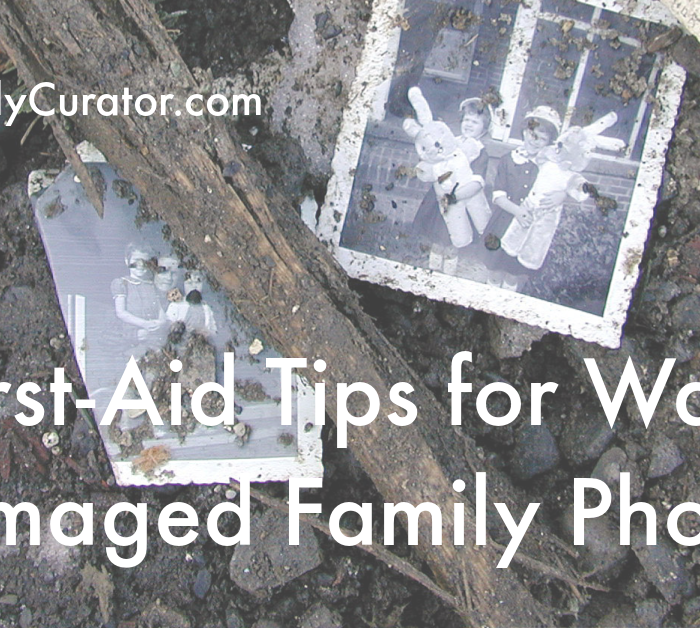
    5 First Aid Tips for Water Damaged Family Photos

    Wet recovery workshop

    In the wake of Hurricane Sandy, thousands of family historians may be facing the task of salvaging precious family photos, papers, and heirlooms. Salvage efforts should begin within 48 hours, according to the National Center for Preservation Technology and Training.

    Here are a few first steps to help with your recovery efforts of family photos:

    1. Photographs and paper items will be extremely fragile when wet; handle with care. Avoid touching the print surface.

    2. Framed photos that become wet should be removed from the frame to air dry flat, when possible. Remove frame backing, loosen edges, and gently free prints from frame.

    3. Rinse photos gently with clear water to clean off silt and debris without touching the surface of the print.

    4. Air dry wet items indoors if possible. Encourage air circulation by opening windows, running room fans,  air conditioners, and dehumidifiers. 

    5. Do not store damp items in plastic bags -- this will cause mold to grow. If you need to store temporarily in plastic containers, leave the lid off or ajar and encourage air circulation.

    Consult a professional conservator for further restoration treatment.

    This information is adapted from Disaster Response & Recovery, American Institute for Conservation of Historic and Artistic Works, and Disaster Recovery Conserve-O-Gram, National Parks Service, National Center for Preservation Technology and Training

    Further Resources

    National Institute for Conservation
    http://www.heritagepreservation.org/PROGRAMS/TFRespRecover.html
    National Parks Service, National Center for Preservation Technology and Training
    http://ncptt.nps.gov/managing-collections-in-a-disaster/

    Download NCPTT Disaster Recovery Conserve-O-Gram pdf

    Photo: NCPTT Wet Recovery Workshop, 2008.